About Lethwei Bando
Burmese Martial Arts (Thing-Self Defense)
History books of old Burmese culture can be studied to seek knowledge regarding the fighting and defense techniques in old times and very useful also to get information pertain to their cultural back ground, the reality about the initial stages of Martial Arts would be acknowledged. This kind of reality which is like hidden treasure from this world needs to come in knowledge the general public.
Thaing (Self Defense) had been practiced in Burma centuries before the British occupation. Each system interprets the art differently among the tribes. Some use the term Bando instead of Thaing for the entire art incorporating both armed and unarmed methods.
Lethwei (Kick Boxing) or Muay Thai
By specific primary training to the followers the Thing, Bando and Banshay there is also the Burmese Kick boxing called (Myanmar Letwai) and wrestling (Naban) which are very famous Tiger Kick Boxing. Since 1970 the training of Bando kickboxing programs are conducted. Kick Boxing is a full contact sport based from Burma that is now called the Myanmar where this sport was once popular as the (Sport of Kings). The Royal Boxers were considered as part of Justice by Royal family.
The term "Bando" is a combination, composed from the Burmese words "Ban" and the Japanese term (suffix) "do"; it is generally held to have three primary meanings. Bando schools Very in their methods but they all adhere to teaching first the foothold and basic postures. Next, blocking and parrying forms are taught (there are at-least nine major ones.) Finally offensive techniques are passed to the students with the injunction to use care. Bando stresses an initial withdrawals, attach from outside the opponents arms and much open hand work to the body. The parts of body as elbow, hip, head, shoulder, foot and knees are all employed in fighting which favors close quarters. For this a 'midget punch' has been developed. Grapping and dlocking techniques follow the initial strikes. Kicking usually is of the free rather than snap type and is economical and effective. Techniques are learned through forms, then with a partner of partners and finally used in contests.
Marco Polo, the great traveler from Venice, stared in amazement. He had never seen anything like it before. He was as an intelligence officer for the army of Kublai Khan the Mongol Emperor of all China. Marco Polo Was present in 1277 when the Golden Horde met the Army of Mien and Bangala (the combined kingdoms of which are now called Burma) in battle. Bando is not karate in the strictly western sense of the world (which means a system exclusively employing kicks and punches). All the fighting system of the Far East taught the use of weapons to those of higher rank. The Burmese system, however, since it has so long been an underground art without commercial value does not give the notice the impression that he could say the magic word 'BANDO'.
The Bando practitioner learns early in his training that he is expected to be men- tally flexible in his fighting; indeed, in the empty hand aspect of Bando when contrasted with karate, this is one of the most discernible differences. The student does not adhere to the rigid stance of many of the other Oriental fighting disciplines. In fact the average opponent in a street fight probably would not realize be was engaging in a fisticuffs with a devotee of an Eastern fighting art. Because of the flexibility of movement of a Bando man, he may shuffle from Side to side, twist his body in a thousand gyrations and use his hand more than is considered proper for most students in most karate systems.
The Bando student under the British Occupation had no time or reference to decide whether or not he had scored a point with a well-focused, well-placed blow. He had to demolish his opponent and get away quickly before the local constabulary arrived, especially if he were not already engaged in fighting member of that august body at that particular moment. Therefore the trainee learned to get in close, standing right in next to his opponent and delivering a series of hand and knee blows. It cannot be stressed too - strongly that even in the American version of Bando, when bouts are held, points are not given for one blow scored, as in the more Conventional forms of karate but for a series of four blows.
Another difference between Bando and karate is a series of snapping blows called "Cobra punches" which are not similar to karate reverse punches, since the hand is not brought all the way back to the side but instead is shot out in a rapid series jabs. Speed in delivery and return of the hand is stressed. Adherents of no-contact karate will probably wince when they learn that Bando fighters believe in hard contact since they consider their techniques constitute a deadly martial art, not a sport.
Their pattern of circular hand movements can best be described as a wind mill effect - as if someone were standing in front of a wind- mill and getting chopped to pieces by its moving blades. Bando instructors preach that there are nine points of fighting, north, south, east, west, oblique left, and right. Rear left and right, up and down. In other words every aspect of the four quarters of the compass are what a man must be aware of he is judging the distance from which to fight because Bando fighting is more free flowing than karate it does not mean that discipline in the dojo is not strict. It is, the term "Bando" embraces three main martial art concepts:
(a) .…A way of discipline
(b) ….Systems of defense
(c) ….The art of fighting or combat
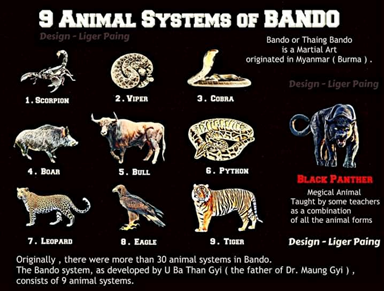
Animal System 12 Old 9 New
- Boar
- Bull
- Cobra
- Eagle
- Panther
- Python
- Scorpion
- Tiger
- Viper
- Deer
- Monkey
- Heron
(Naban) means grappling art means hand to hand wrestling and meditation and health or physical aspects of the system invented by Buddhist Monks to teach of animal styles and forms of weapons always force to for defense as well as efficiency.
Banshay (Armed)
Banshay (armed fight derives from both the Indian and Chinese sources. The sword, staff and spears are the major weapons and systematic methods have been built around all three weapons Bowers describes the Shan (tribe) sword dance. The Offensive striking methods number at least twelve in Bando. In fact and without a doubt it can be said that the Bando is soft and skill but also deadly, vital and dynamic form of fighting. The sword dance is the second step in Banshay. Though the Burmese swords are pointed they are much lighter than the European and Japanese swords. It could only wielded by the strength of the wrist. Traditionally, there are 37 forms associated with the sword and they are taught very carefully.